
By Elton Hayes
Habitat for Humanity of Greater Centre County (HFHGCC) established itself in the centre region more than four decades ago. Congregants of the UniversityBaptist and Brethren Church (UBBC) trekked to the nonprofit organization's headquarters in Americus, Georgia, seven years after its founding.
State College, PA — UBBC members returned with inspired to rid Habitat for Humanity’s vision of access to affordable homes and home renovations to those in the Centre Region, making HFHGCC one of the first affiliates established in Pennsylvania.
The organization built its first home in Bellefonte in 1985.
Forty years later, and now under the leadership of Executive Director Stephanie Fost, HFHGCC will soon experience another first when construction on its most recent new-build home is completed this year.
The 1,333-square-foot Boalsburg dwelling will be the first 3D-printed home in the commonwealth, as its exterior walls were constructed with 3D-printed concrete.
The organization collaborated with State College-based 3D-printing company X-Hab 3D on the undertaking after then-board member Ken Kline-Smetzler listened to a representative from the company share information about the technology at a local event a few years ago.
“X-Hab 3D hosted an information session for the community, and they invited housing folks from across the community,” Fost says. “One of our board members attended and came back and said, ‘We should consider talking to them.’ I ended up talking to them, and we just continued the conversation and talked about it for a very long time, trying to figure out what the next steps look like for us in this community.”
HFHGCC purchased the lot on which the foundation rests from Harris Township in the summer of 2024. The municipality originally bought the parcel approximately 20 years ago and has used it for storage.
“It turns out that Penn State had been working on very similar technology all the way back to around 2015, where my co-founders had started what is now called Penn State’s Additive Construction Laboratory. These folks are at the forefront of 3D concrete printing on a world-class stage.”
X-Hab 3D was co-founded by a quintet, four of whom boast Penn State ties: Dr. Sven Bilén, an engineering professor; Professor José Duarte, director of the Stuckeman Center for Design Computing and Stuckeman Chair in Design Innovation; Shadi Nazarian, a former Penn State professor; and Nathan Watson, who earned bachelor’s and master’s degrees from Penn State.
X-Hab 3D CEO and co-founder Bruce Kraselsky lives in Northern Virginia but travels to State College nearly weekly. The native Floridian received his Juris Doctor from the University of Florida and once harbored ambitions of becoming an astronaut. While his dreams of NASA never came to fruition, he did find his way into the international space and telecom law arena.
The beginnings of X-Hab 3D can be traced to Kraselsky’s seventh entrepreneurial venture, which occurred in Alaska. The project centered around providing Alaska’s rural communities with affordable satellite broadband.
That venture, his second in Alaska, led to Kraselsky being tasked by the Alaska Department of Commerce to help address the housing situation of Alaskans living in off-grid communities through alternative technologies. With the concept of 3D printed concrete still fresh in mind after having recently read about it, Kraselsky mentioned the technology as a possibility.
“Before I knew it, they were asking me if I would lead a federally funded study to determine whether the technology was feasible in Alaska,” Kraselsky says.
It didn’t take Kraselsky long to locate his technical team.
“I found that Penn State had won all these awards in NASA’s Mars Habitat competition for 3D concrete printing technology for the moon and Mars,” he says. “They bested 70 international teams from around the world. So I reached out to Penn State to the folks I knew were the leads on this particular program and asked if they would be interested in participating with me in this feasibility study. They would immediately say, ‘Yes. We’d love to participate.’”
Not only did the team ultimately determine that the technology was feasible in many areas of Alaska, but over the course of those six months, the group also decided it would come together and form a company to make the technology accessible in the private sector. X-Hab 3D officially launched in October 2021.
“It turns out that Penn State had been working on very similar technology all the way back around 2015, where my co-founders had started what is now called Penn State’s Additive Construction Laboratory,” Kraselsky says. “These folks are at the forefront of 3D concrete printing on a world-class stage.”
Fast-forward a few years to when Kline-Smelter found himself in X-Hab 3D’s State College facility observing the team members demonstrate how the 3D concrete printing process along with the benefits it brings to home construction.
“It seemed like an interesting idea, and I felt like if they would be willing to work and donate by putting up the walls, we’d give them free publicity,” Kline-Smelter recalls. “It was a good, collaborative project.”
Kline-Smelter no longer serves on HFHGCC’s board, but he says he has driven past the home a couple of times to track its progress. While the fruits of HFHGCC’s and X-Hab 3D’s labor are life changing, the process to bring the project to fruition was years in the making. All firsts come with no shortage of challenges.
Fost and X-Hab 3D’s brain trust pored over the specifics and logistics of pursuing such an endeavor. Fost also tapped into Habitat for Humanity’s affiliate network with questions specific to 3D construction methods. Habitat for Humanity has more than 1,500 affiliates in all 50 states, the District of Columbia, and Puerto Rico, but only two affiliates have used 3D printing to construct homes. That fact, understandably, made the process a bit more challenging to navigate.
Nonetheless, she leaned on those resources.
“The first one was in Tempe, Arizona, so I reached out to them and got some information,” she says,
“Habitat for Humanity Peninsula and Greater Williamsburg in Virginia have done one, and I think at this point, they’ve done four 3D-printed homes. Our construction supervisor and I both reached out and talked to other people at those organizations.”
Fost and X-Hab 3D took the information gleaned from dialogue with the two affiliates and dug their proverbial heels in. Countless conversations followed as the two entities and others tasked to help the build formulated a collective plan.
While conversations with the affiliates in Arizona and Virginia proved invaluable, Fost says perhaps the most important advice she received throughout the early stages was to ensure her organization and the local code office remained congruent.
Fost credited Centre Region Code Administration with helping perhaps the most pivotal entity in making HFHGCC’s and X-Hab 3D’s vision a reality. Safety, she says, remained at the forefront.
“(HFHGCC’s) emphasis is that we are building safe and affordable homes,” Fost says. “I will never allow our organization to stray from that — it’s our core principle.”
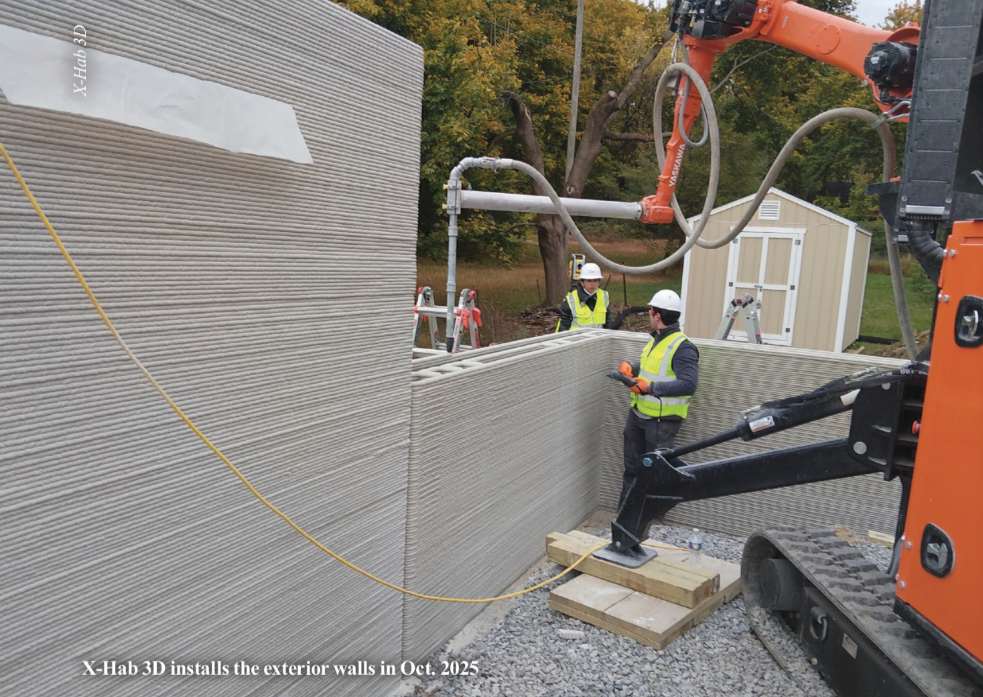
After several years of planning, HFHGCC broke ground on the home last fall. X-Hab 3D started construction of the exterior walls on Oct. 13.
The process of printing the exterior walls of the HFHGCC home began with pouring the footings around the perimeter of the home, a technique different from the traditional method of pouring the foundation slab first and working around it.
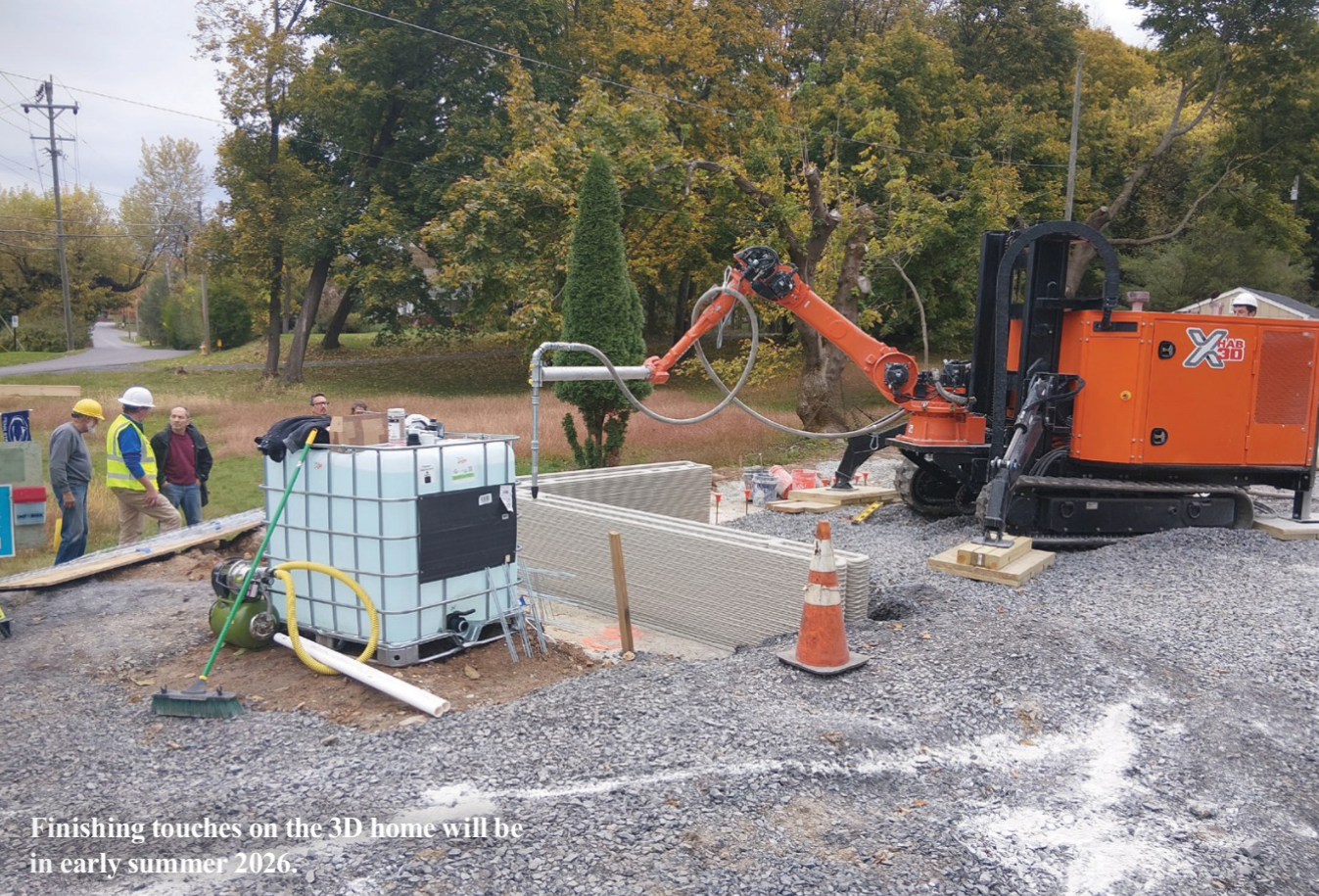
From there, X-Hab 3D’s crew printed the walls on top of the footing using its mobile 3DCP system. The process took approximately a week to complete. Once the walls were finished, with cutouts for the doors and windows, a crew placed the home’s roof atop the four walls. In early January, a cement truck then visited the property and poured the foundation slab through the door and windows.
“In other words, they used the walls as the formwork that would have otherwise had to have been created with wood and by labor in order to pour the slab,” Kraselsky says. “We printed and then used the print as the formwork, which was faster and less expensive. Also, because we had the walls printed first and then poured the slab up the walls, the slab bonded with the walls, so there can be no leakage.”
According to Kraselsky, the technology has its benefits when it comes to sustainability. Rather than the traditional batt insulation almost commonly used in wood-frame structures, X-Hab 3D’s use of closed-cell foam insulation in combination with its 3D concrete-printed walls dramatically increases a home’s energy efficiency.
“Not only is it a very good insulator, but it also serves as an air and weather barrier,” Kraselsky says. “By printing the walls and pouring the closed-cell foam insulation, we basically — all in one — do the work of about five trades that would need to be serially involved to do the same thing with conventional construction.”
In addition to its energy efficiency, Kraselsky says, due to its use of concrete for the exterior walls, HFHGCC’s latest home is “more storm-resistant, more fire-resistant, and insects won’t eat it. You won’t have termite issues.”
HFHGCC and its network of local volunteers typically complete one new-build home per year. The organization also provides renovation services and repairs to owner-occupied homes.
Although the faces of HFHGCC in the years since its inception have changed, its commitment to providing affordable, safe housing options for those in Centre County remains as strong as it did more than 40 years ago.
In fewer than six months, the organization will be able to add another first-time homebuyer to its list.