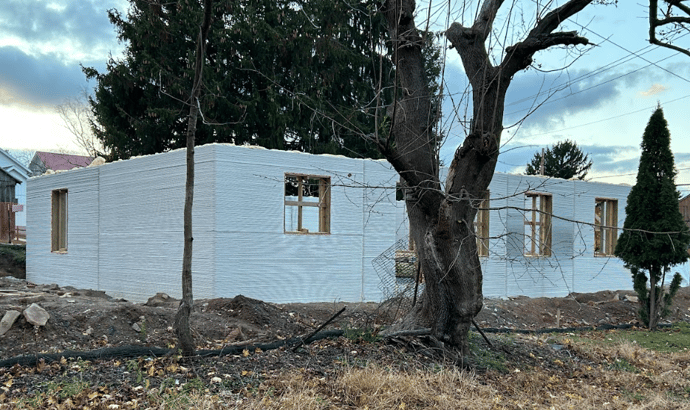
Pennsylvania’s First 3D-Printed Home: Built with Habitat for Humanity
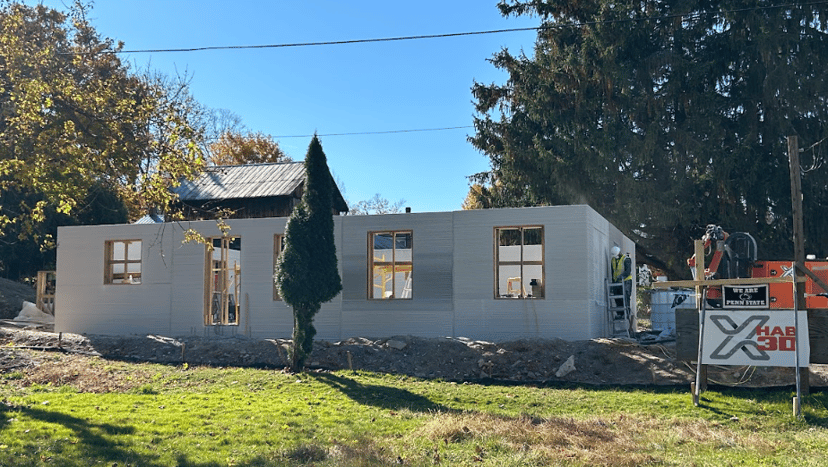
Pennsylvania's first 3D-printed home was built in Boalsburg, Pennsylvania, using X-Hab 3D’s mobile system in collaboration with Habitat for Humanity. This project demonstrated how X-Hab 3D’s mobile, self-powered 3D concrete printing (3DCP) system can accelerate affordable housing construction while integrating seamlessly with local code workflows and community-driven build processes.
Project Details
Location: Boalsburg, PA (Centre County / State College region)
Structure Size: 45.5′ × 33.5′ × 9′10″
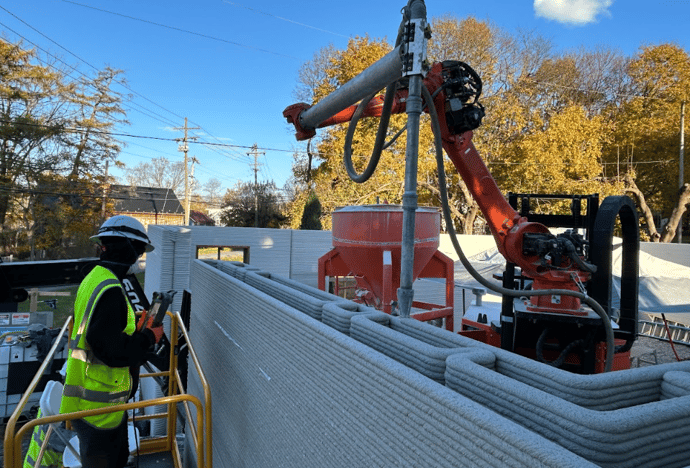
Printer Used: X-Hab 3D’s Mobile 3DCP System
Material Source: Sika USA 3DCP mix — fully compatible with X-Hab 3D’s mobile mixer/pump system
ABOUT THE BUILD
This project was set up to use 3D concrete printing on a Habitat for Humanity home and to see how the approach fits into a typical residential neighborhood. The work needed to stay within Habitat’s budget, local code requirements, and the township’s permitting process. It also had to be something a community organization could repeat for future builds.
One of the main goals was to show that the printer could operate without a structural slab, using poured footings and compacted gravel instead. Another priority was creating a process that worked alongside Habitat volunteers, inspectors, and local trades, giving everyone involved a clear look at how 3DCP fits into a standard housing project.
ON-SITE PRINTING
The home was printed directly on poured footings and compacted gravel, removing the need for a pre-poured slab. The printer leveled and stabilized itself on the gravel base, and the wall geometry remained consistent throughout the print.
The design called for the printed walls to double as formwork for the future slab. Once the roof is attached, the slab will be poured through the window openings, simplifying scheduling and reducing material use.
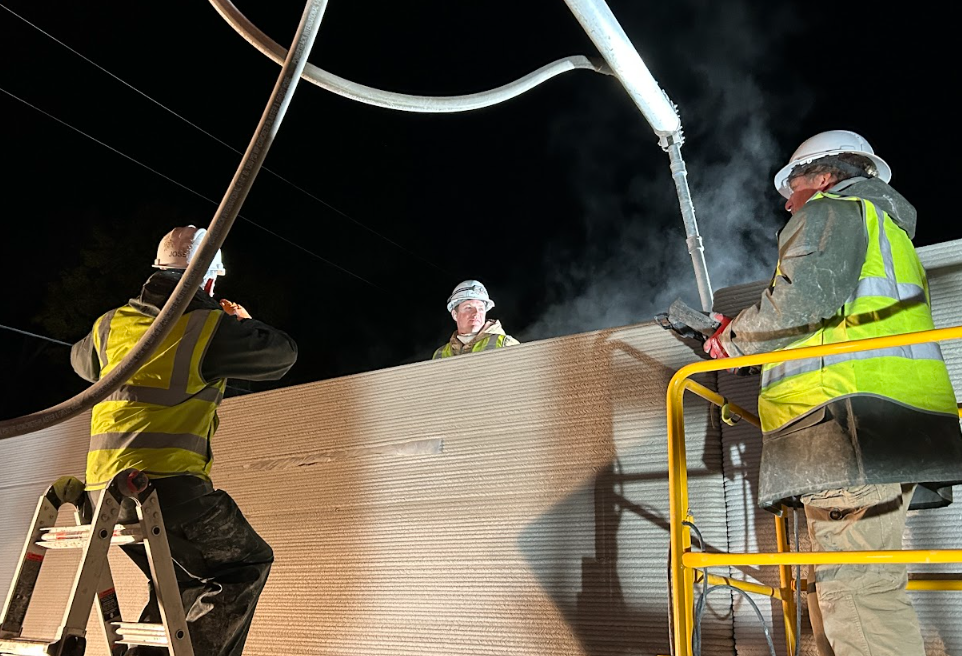
The project required coordination between Habitat volunteers, inspectors, engineers, and trades to keep the build aligned with local code requirements. Insulation planning was integrated into the printed wall cavities, which were later filled with closed-cell spray foam to support long-term energy performance.
WHY IT MATTERS
The Boalsburg project produced practical information on how a mobile 3DCP system performs on compacted gravel and on printed walls serving as formwork for a slab. The consistent output of Sika USA's 3DCP mix provided a clear reference point for future residential builds, and the process created a usable example for township permitting of 3D-printed homes in Pennsylvania.
From a community standpoint, the project showed that 3DCP can reduce labor demands on nonprofits and local builders while fitting into typical suburban neighborhoods. It also demonstrated an approach that could support smaller municipalities, rural regions, and areas facing labor shortages.
Ron Fetzer & Spray All (closed-cell foam insulation)
This collaboration reflects a strong regional commitment to innovation, community development, and housing accessibility.
Ready to Support Affordable, Resilient Housing
The Boalsburg project shows that 3D concrete printing and X-Hab 3D are ready to support affordable, resilient housing — bringing advanced technology and community mission together to build smarter and stronger.